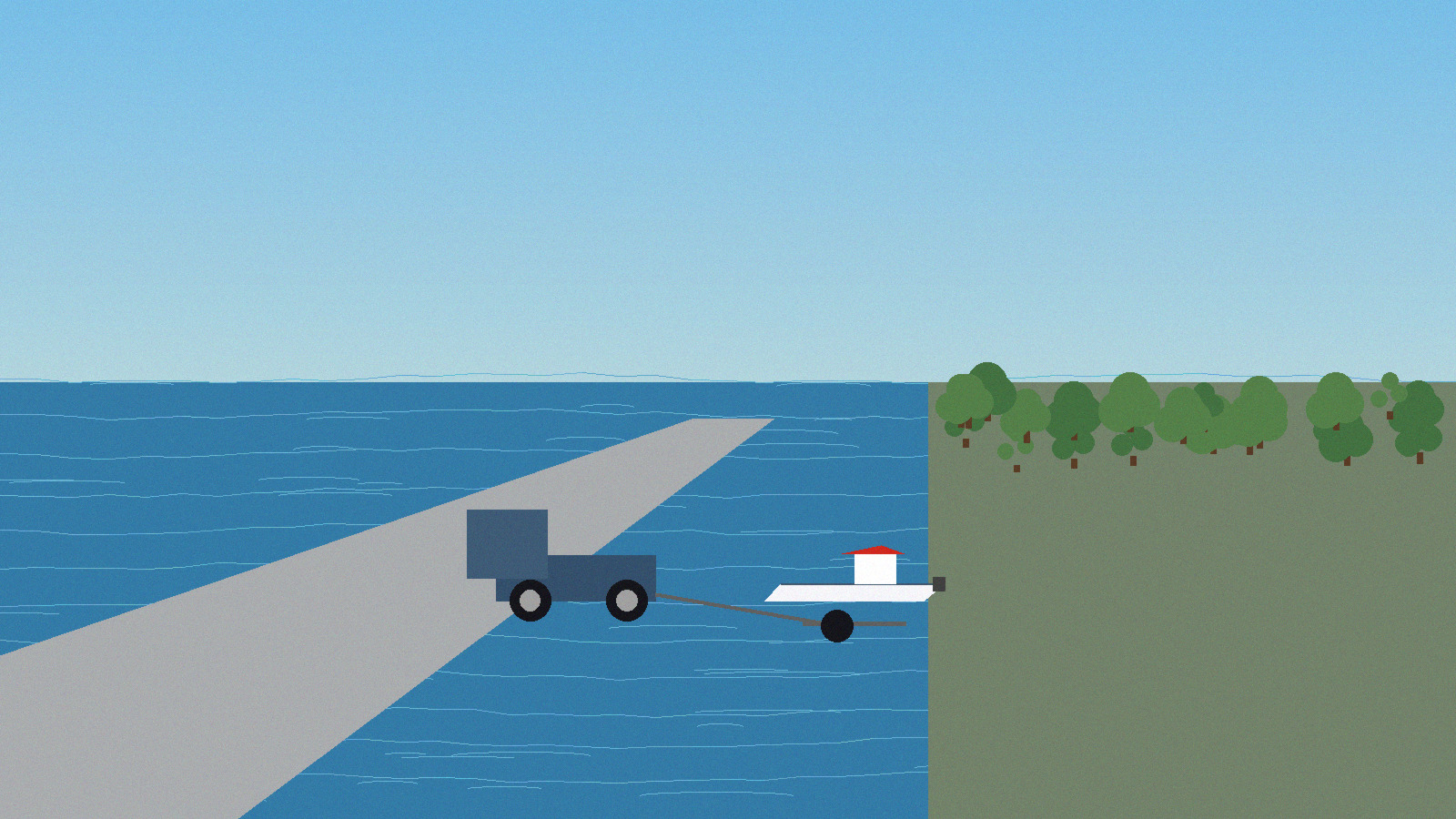
Trailer backing embarrasses people because every mistake gets amplified in reverse. Small steering inputs create bigger trailer angle changes, and the moment panic hits, most drivers steer too much. Then the trailer jack-knifes, the truck blocks the lane, and the whole launch feels cooked before the boat even touches water.
The good news is that trailer backing is teachable in a very mechanical way. You do not need a special gift. You need a repeatable routine, slower hands, and a refusal to rush because somebody is waiting behind you. Rushed backing is how fenders get scraped, tempers spike, and the launch becomes harder than it has to be.
Ontario ramps also add variables: wet concrete, algae slicks, side wind, uneven parking lots, and other users who may be in a hurry. That makes it even more important to separate staging from launching. Get ready in the parking area, then move to the ramp only when the boat, lines, straps, and crew are actually set.
<div class="stat-card">**2**<span>Mirrors always</span></div><div class="stat-card">**10/10**<span>Reason to stage first</span></div></div>Build the ramp routine before you ever start reversing
Good launches begin in the staging area, not halfway down the ramp. Load gear, put drain plug in, prep lines, remove tie-downs that should come off before launch, and decide who is doing what. When people try to finish all of that in the ramp lane, everything backs up and the driver starts reversing distracted.
Your mirrors are your main cameras. Set them to see the trailer tires and both edges. If you have a backup camera, great, but do not depend on it alone. A trailer can disappear from view at the worst angle, and camera depth can mislead you. Mirrors tell the real story over time.
Pick the exact path before moving. Which lane? Which side of the dock? Is there wind blowing the stern one way? Is the ramp steep, slick, or busy? The best backing job is the one that was planned while the truck was still stationary.
-
Stage gear away from the ramp lane.
-
Use the same checklist every time so launch days feel familiar.
-
Do a quick walk-around and look for straps, bungs, cables, and obstacles.
Understand the pivot so the trailer stops feeling random
When you reverse, the trailer moves opposite the initial direction of the steering wheel at the back end. That is why beginners get twisted up. The trick is not to memorize a thousand rules. The trick is to move one hand to the bottom of the steering wheel and think about where you want the trailer to go.
If your hand is at the bottom of the wheel and you move your hand left, the trailer tends to go left. Move your hand right, the trailer tends to go right. That shortcut helps a lot of people because it matches what they see in the mirrors instead of making them mentally flip everything.
The second key is this: early, tiny correction beats late, big correction. Once the trailer angle grows too much, you are no longer guiding it. You are rescuing it. Keep the angle mild and the whole system stays manageable.
The truck follows the trailer, not the other way around
Beginners often stare at the truck line. Watch the trailer line instead. Your job is to place the trailer where it needs to go, then let the truck follow that arc. If you focus on truck position first, you end up making corrections that feel good for one second but ruin the trailer track.
Use the slowest pace that still keeps you in control
Reversing too fast is the classic mistake. The trailer reacts quickly, but your brain reacts slower when stress is high. That mismatch is where overcorrection is born. Back slowly enough that you can make one decision at a time and watch the result in the mirrors.
That does not mean paralysis. It means controlled crawl. You should be able to stop, breathe, and continue without drama. At a crowded ramp, pressure from waiting vehicles can tempt you to speed up. Ignore it. A clean slow launch is faster than a rushed bad one followed by a reset.
If the angle starts getting ugly, stop before it becomes a spectacle. Pull forward, straighten out, and try again. The smartest trailer operators use pull-ups early because they know that saves time overall.
Mirror discipline and sight picture
Do not dart your eyes around randomly. Develop a pattern. Left mirror, right mirror, far end of the trailer, ramp edge, dock, then back again. That rhythm keeps you oriented and prevents fixation on one side while the other side quietly drifts toward trouble.
If the trailer disappears from one mirror completely, that usually means the angle is becoming too sharp. That is your cue to stop and reset, not to keep turning harder and hope for a miracle. Hope is not a trailer-backing strategy.
Use reference marks. Watch the trailer tire relative to the painted edge, the concrete seam, or the dock face. Backing becomes easier when you stop thinking in broad feelings and start reading real physical references.
Ramp-specific issues: slope, algae, and side wind
Launch ramps are not empty parking lots. Slope speeds everything up. Algae can reduce traction. Crosswind can push the boat and trailer together. A steep ramp may also hide the lower end of the trailer from view sooner than you expect. That means your setup at the top matters even more.
Take extra care with foot placement if you are getting out to inspect. Wet concrete and slimy edges can put you down fast. Keep the parking brake habit strong during staging and hold the vehicle secure whenever anyone exits on the ramp.
Wind deserves respect before the boat is floating too. A side gust can start pushing the hull on the trailer or make the launch line matter sooner. Brief your crew on where they should stand and which line they need first.
-
Treat green slick patches like low-grip zones.
-
Do not rush transitions between vehicle control and crew movement.
-
Think about wind before the stern floats free.
A repeatable backing sequence for real launches
Start straight. Straight is your friend. The less turning required at the top, the easier the rest becomes. Once reversing, make tiny bottom-of-wheel inputs and pause. Watch what the trailer does. Correct again only after you know the first correction worked.
As the trailer lines up with the ramp, your job shifts from getting the trailer pointed right to keeping it there. That means reducing correction size even more. Many people ruin a good line because they keep turning after the trailer is already on track.
Near the water, keep your head. This is where spectators, crew movement, and nerves can make people abandon the method. Stay with the same process you used in the parking lot drill: slow, pause, read, correct.
How to practise without wasting a launch day
Find an empty lot and use cones or chalk lines to simulate a ramp lane. Practise starting straight, making slight turns, and pulling forward to reset. Do it until the sight picture through your mirrors starts feeling normal. The point is to burn the panic out before a real crowd is watching.
Then move to a quiet ramp at an off-peak time. Practise backing down partway, stopping, and pulling out. You do not have to launch every time to build the skill. Many drivers wait until a high-pressure holiday morning to learn, which is the worst possible timing.
The fastest route to looking competent is not to hide from practice. It is to separate practice from performance and make each one intentional.
What a clean ramp operation looks like
The vehicle arrives staged. The boat is ready. The driver backs steadily with tiny inputs. The crew stays out of dangerous positions and does not improvise. The trailer enters the water on line. The boat launches without shouting, blocking, or panic. Then the truck clears the lane quickly so the next person can work.
That is the standard worth chasing. Not one-shot perfection. Just clean process, repeatable every time. Once you can do that, the ramp stops feeling like a judgement zone and starts feeling like another routine part of boating.
</div>