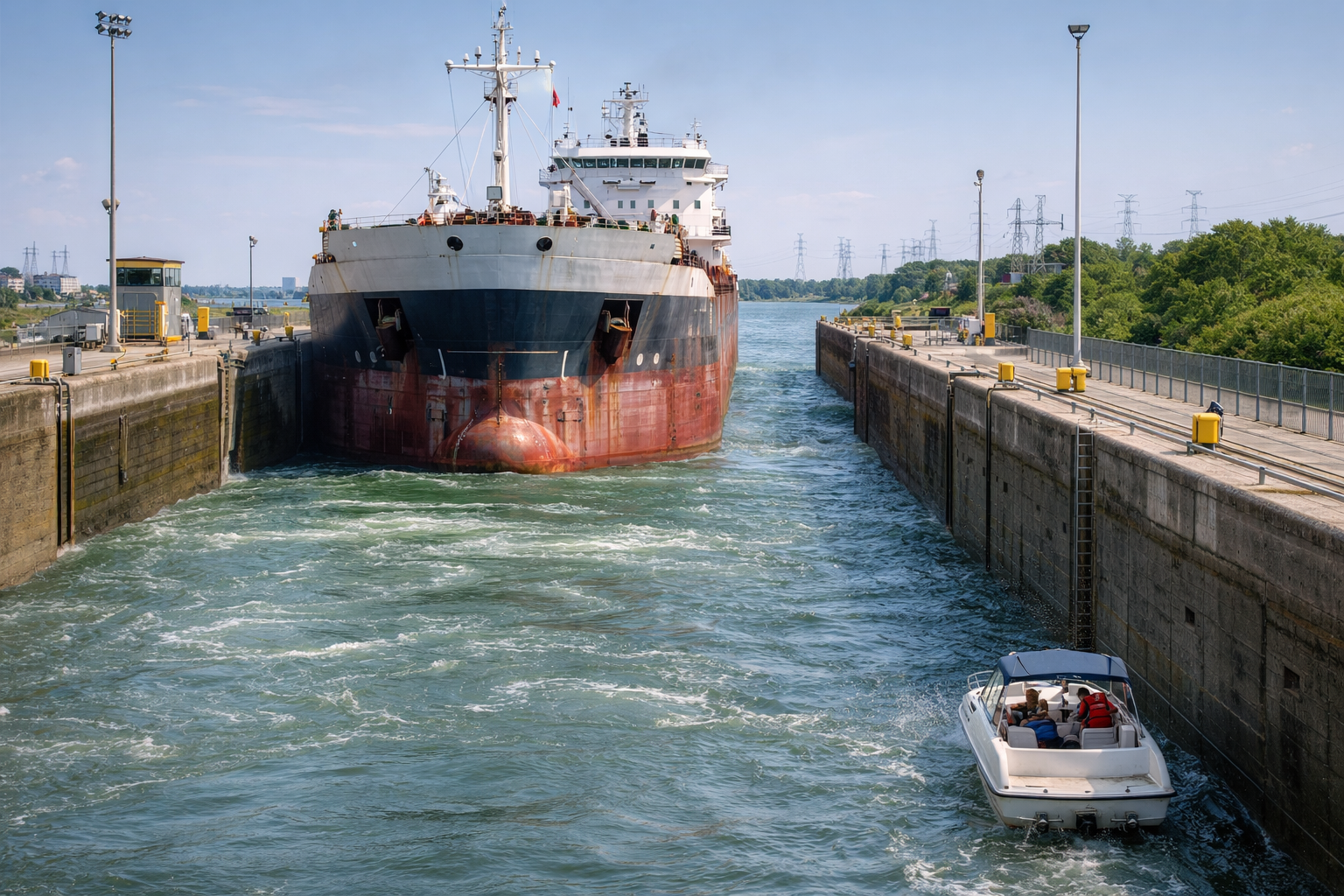
Boating traffic rules feel confusing to beginners because the water looks wide open. In reality, you are still managing closing speed, crossing angles, blind spots, and human judgment. The difference is that painted lanes are mostly gone, so you have to understand the rules instead of relying on road markings.
Good collision avoidance is built on two things together: knowing the formal stand-on and give-way concepts, and being willing to act early when the real situation starts getting messy. Legal theory means very little after a close-quarters hit.
Ontario waters add commercial traffic zones, busy recreational channels, river currents, lock approaches, and tight harbour mouths. That means you need more than a slogan. You need a working picture of who should maintain course, who should alter, and how obvious your action should look to everyone else.
<div class="stat-card">**Early**<span>Best time to act</span></div><div class="stat-card">**0**<span>Value in last-second ambiguity</span></div></div>Stand-on and give-way in plain English
In many encounters, one vessel is expected to maintain course and speed as the stand-on vessel while the other gives way with a clear manoeuvre. The reason is predictability. If both boats improvise at the last second, nobody knows what the other is trying to do.
That said, maintaining course does not mean switching your brain off. You should still be evaluating whether the give-way vessel has seen you, understands the situation, and is actually acting. If not, you may need to alter or slow to keep the situation safe.
Think of right-of-way as a framework for clarity. The entire point is to reduce surprise. Surprise is what causes a lot of close calls on summer waterways.
-
Know the rule, then watch whether the other operator appears to know it too.
-
Make course changes large enough to be obvious, not tiny enough to be invisible.
-
Use sound judgement before pride.
Head-on situations
When two power-driven vessels approach head-on or nearly head-on, both should generally alter course to starboard so they pass port-to-port. This is one of the simpler rules conceptually, but poor visibility, distraction, or slight offset can still make the encounter ambiguous.
If the other boat is holding an odd line, do not freeze. Slow if needed, communicate by obvious movement, and give the situation more room. Small uncertain twitches create confusion. Clear movement reduces it.
At night, proper navigation lights become a huge part of recognizing a head-on or near head-on picture. If you are not fully comfortable reading that at speed, slow down long before the encounter becomes close.
Crossing situations
When two power-driven vessels are crossing and there is risk of collision, the vessel with the other on its starboard side is generally expected to give way. In plain language, if the other boat is coming from your right in a crossing situation, you are usually the give-way vessel.
The safest give-way action is usually early, substantial, and easy to interpret. That might mean a course alteration, speed reduction, or both depending on context. Whatever you do, make it readable. Hidden half-decisions are where misunderstandings live.
Do not keep pushing into a crossing because you think there is still technically room. Closing speed on the water deceives people constantly, especially with different hull sizes and angles.
Power versus sail, and what 'restricted' really means
Sailing vessels often receive priority over power-driven vessels in many ordinary meeting situations, but the real world is more layered than bumper-sticker rules. Vessel type, manoeuvrability, and local conditions all matter. Large commercial traffic, vessels constrained by draught, ferries on fixed patterns, and traffic in narrow channels deserve special respect.
A small recreational boat should never assume size does not matter. In canal systems, harbour approaches, or commercial corridors, the larger or more constrained vessel may have very limited ability to alter safely. The wise operator gives extra margin instead of trying to litigate the encounter in real time.
If you find yourself wondering whether the other vessel can easily move, your safest assumption is that it may not be able to move as quickly or as gracefully as you hope.
Narrow channels, harbour entrances, and locks
These are the places where textbook confidence gets tested. In narrow channels, it is often necessary to stay well to the appropriate side, maintain a predictable path, and avoid obstructing traffic that has less room to manoeuvre. Harbour mouths and lock approaches compress time and space even further.
Do not drift aimlessly near channel entrances while sorting gear or chatting. If you are not committed to transiting, get clear of the working lane. Recreational hesitation in high-traffic bottlenecks causes a lot of stress for everybody around it.
Locks and canal sections add posted rules, signals, and local operating instructions. Read them, obey them, and do not freestyle because the water looks calm.
Wake, overtaking, and courtesy that prevents conflict
Overtaking requires patience and awareness. The overtaking vessel carries responsibility to keep clear and complete the pass safely. Just because you can pass does not mean the current, wake, or visibility makes it smart to do so right there.
Wake management is also a right-of-way-adjacent issue because your actions affect the control of nearby boats, docks, paddle craft, and shoreline users. Throttle decisions in crowded or sensitive zones are not purely about your boat. They are about everybody forced to react to your water.
Good operators read the social layer too. Courtesy is not weakness. Courtesy reduces the number of situations that ever get close to a formal rule decision.
How to stay out of trouble even when the other guy is questionable
Scan constantly. Watch for relative bearing that does not change. That is one of the classic signs of collision risk. Slow down earlier than feels necessary. Give wider berth than the minimum. Build habits that leave room for another person's mistake.
If another operator is erratic, do not try to teach a lesson. Create distance. The water is full of people with mixed skill levels, mixed sobriety, mixed equipment knowledge, and mixed patience. Your survival strategy is to make their problems less relevant to your boat.
The goal is simple: nobody should have to wonder what you are doing, and you should never rely on somebody else being sharp at exactly the right second.
Bottom line
Learn the formal rules, then add what really keeps people safe: earlier decisions, wider margin, and less ego. That combination prevents far more collisions than rule recitation alone.
</div>